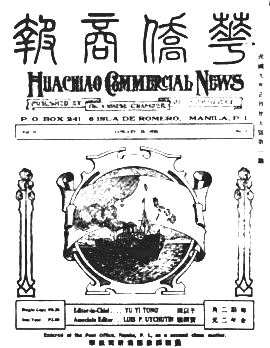
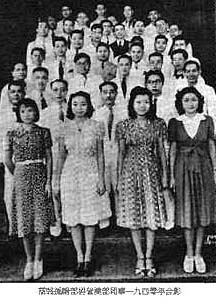
The Chinese Commercial News was established
in October, 1919. It began as the monthly newsletter of the Manila
Chinese Chamber of Commerce. The editor was Mr. Yu Yi Tung, the
secretary general of the Chamber. The business manager was Mr. Na Tim.
Dr. Huang Kai Chong, former professor at Xiamen University, was
commissioned to write on economic and business issues. This allowed the
Chinese businessmen to acquire economic and business knowledge and at
the same time gave support to the development of unity and cooperation
between overseas Chinese organizations and the community.
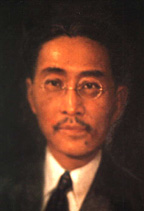
The president of the
Chinese Chamber was Mr. Dee Cheng Chuan (Dee C. Chuan). He was elected
chamber president in 1919 and served 6 consecutive terms. It was the era
right after the first world war and a period of much development in the
financial and business field. Competition for markets was the order of
the day and one of the markets was the Philippines. Since the primary
occupation of the Chinese in the Philippines being commerce, to remain
in competition and to attain growth, sufficient modern business strategy
was necessary. To keep up with the times, up-to-date information of
changes in the marketplace was needed. This was the rationale behind the
establishment of the Chinese Commercial News by Mr. Dee Cheng Chuan.
At that time, the
Chinese community was united in the fight against the law for the
implementation of western accounting method. At the same period saw the
emergence of a long-term financial institution -- the China Banking
Corporation. It was a turning-point for the Chinese community in the
Philippines and we can say that the Chinese Commercial News was a
creation of that era.
The Chinese
Commercial News was published as a monthly for 2 years and 4 months,
then it was converted to a daily paper. The last issue as a monthly was
February, 1922. The daily paper was advocated by business tycoon Mr. Go
Ki Hoc. He gathered capital and established the Chinese Commercial News
Publishing Co. The wealthy merchant, Mr. Go Kiek Seng was designated as
the business manager and Mr. Young Tiong Sin, treasurer. The daily
started in April, 1922. At the beginning, it was only 2 pages with
circulation of less than a thousand. Foreign and local news were
translated from English papers.
In the first issue,
Mr. Yu Yi Tung, the publisher, stated the following editorial policies :
1) Coordinate Chinese organizations
2) Expand overseas business
3) Develop business investments in China
4) Disseminate business knowledge
5) Report business news
6) Improve relationship with the local community
7) Eliminate the class difference between capital and labor
8) Provide leadership for the Chinese community
9) Encourage the improvement of education for the local Chinese
10) Support political reforms in China
Five years after
the establishment of the daily, it came out with the first pictorial
among Chinese newspapers. In 1933, a weekly magazine was added. The
contents of the daily continued to improve in quantity and quality.
The men behind the
Chinese Commercial News have been steadfast in the principle of "no
side, no party" (unbiased and non-partisan).
In the 77 years of
its existence, it has suffered false accusations and attacks from
cliques many times. It has weathered the test of history. Each time it
was vindicated and truth revealed. As early as 1935, on the 15th
anniversary of the paper, Mr. Yu Yi Tung wrote thus "The paper since its
establishment has met trials, suffered attacks."all happened because
"There is deep differences of opinion in the Chinese community. No clear
differentiation of right and wrong. For a time, there were many false
accusations against the paper. The paper maintained its principles,
struggling in the face of difficulties, not intimidated by force or
adverse circumstances. So that those with ulterior motive were unmasked
and people of principle everywhere came to sympathize and love the
paper. The Chinese community came to know and trust the paper."
In the fifty years
hence, the paper has established its stand in the Xi-An incident,
Japanese war, the divisions in the Chinese community after the war,
Korean war, Ruby tower tragedy, mass acquisition of Filipino
citizenship, calamity relief, the Vietnam war. In big and small events,
the paper has faced false accusations, and each time the paper has
remained steadfast to its principle of fairness. Each incident was
overcome. As Mr. Yu Yi Tung said, each incident allowed the Chinese
community to develop its trust.
When world war II
started, the Japanese troops entered Manila on December 1941. The
publisher of the Chinese Commercial News, Mr. Yu Yi Tung refused to
follow the demand to publish the paper as a propaganda organ of the
Japanese. He paid the price with his life. The newspaper was confiscated
and closed. When the allied forces liberated Manila in 1944, nothing was
left of the paper. But on the following year, on April 15, the date of
Mr. Yu Yi Tung*s martyrdom, the paper resumed publication. This
disruption of publication lasted for 3 years and 4 months.
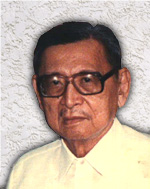
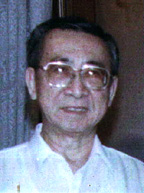
After world war II,
the paper resumed publication without financial or material resources.
With the hard work of the Yuyitung brothers and sister, Tiong Seng (Quintin),
Tiong Kieng (Rizal), Un Hui (Helen ) and Tiong Nay, and the help of
faithful colleagues such as Mr. Yeh Hsieh Min and Mr. Tan Cho Tok the
paper was able to regain its glorious past. In the 60*s, the paper
became the largest circulation Chinese language daily. The pictorial,
the weekly magazine were also restored. In addition, the Manila
Directory of Trade and Commerce was published. During this period, the
prime movers of the papers were jailed twice. Yet the paper did not
ceased publication because of the bravery and faithfulness of its
colleagues and loyalty of its thousands of readers. When the Yuyitung
brothers were forcibly deported to Taiwan, the volunteer legal team in
the Chinese Commercial News case took up its cudgels. Mr. Juan Quijano
acted as publisher and the other lawyers, Joker P. Arroyo, Juan T.
David, Napoleon Rama took over as editors. Circulation and advertising
increased. Not intimidated by the deportation of the Yuyitung brothers
to Taiwan, the paper continued as the leader and advocate of the Chinese
community. This continued until September 21, 1972 when President Marcos
declared martial law. The paper was closed and stopped publication just
as other Philippine media.
The people's power
revolution of February 25, 1986, brought down the Marcos dictatorship
and sent Marcos into exile in the U.S. The ensuring political freedom
saw the return of almost all the pre-martial law English newspapers and
media. The Chinese Commercial News was the only pre-martial law
Chinese-language paper to resume publication. On Philippine Independence
day, June 12, 1986, it returned to meet its many readers.
|