Together We Can Make Dreams Real for Philippine Education
Speech of Ramon del Rosario, Jr
Rotary International District 3780 Annual District Conference 21 March 2009,
Grand Ballroom, Manila Hotel
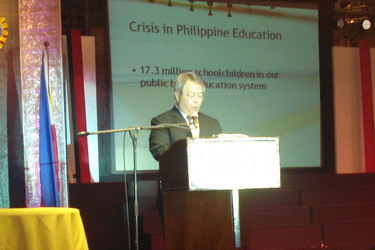
I would first like to express my pleasure for
having been invited as one of your annual district conference guest
speakers.
As you may know, my father was a
long-standing and active Rotary member.
He was a firm believer in the important role
of non-government and people’s organizations in nation-building.
I stand here today to affirm that belief in
our essential roles—each one of us and the groups we belong to—in
REBUILDING this country ravaged by many years of greedy self-interest.
I stand with you today in believing that,
indeed, we can “MAKE DREAMS REAL” especially for the millions of
Filipino children and youth.
Friends, I hope that we all agree that if we are to
address the plight of “disadvantaged Filipino children”, we are not only
talking about a few thousand street children, differently-abled
children, children in conflict with the law or children in war.
For sure, we do need to give attention to
these children in challenging situations.
However, we need to address urgently as well
the situation of over 17.3 million Filipino children who are in our
public schools and another 1.7 million of school age (7-12) who are out
of school.
Our system of education is systematically
making it more difficult for our children to learn to learn and learn to
achieve. In
fact, the system makes it impossible for many to get in and for even
more to stay in.
Today as I speak before you, some 19 million
Filipinos are systematically being left behind.
The Crisis in Philippine Education
In 2006, when we first established Philippine
Business for Education (PBEd) as the business community’s voice for
sustained advocacy in education policy and institutional reform, we
re-echoed former education secretary Butch Abad’s call for action to
address the crisis in Philippine education.
At the 2007 National CEAP Convention, I
proposed that the crisis was one of national proportions, THE crisis of
our age.
Today, our public basic education school system has
a whopping 17.3 million schoolchildren enrolled.
While this seems like a lot, let’s look at
the inverse figures:
-
One in 10 Filipinos, or 6.8 million, has never gone to school
-
One in 6 Filipinos, or 9.6 million, is functionally illiterate
-
One in 3 children or youth, 11.6 million, is not in school
One of the main problems is retention or keeping
our kids in school.
The largest chunk of elementary dropouts
leaves before grade four.
The main reason for this is hunger – the
children, due to malnutrition, are not strong enough to attend school or
concentrate on their classes.
Surprisingly, a substantial number of
students also drop out because of a lack of interest, in part brought on
by the miserable state of their schooling – the shortage of classrooms
and textbooks and the low quality teachers.
As a result, scores of our children and youth
abandon their education and join the ranks of the uneducated and
functionally illiterate.
However, for those who stay in school, their
circumstances are not necessarily better nor their futures necessarily
brighter.
In the 2008 National Achievement Tests (NATs) the
average score among public elementary school students was close to 65
percent and among high school students was an even lower 49 percent, 75
percent is the passing score. In a 2004-2005 Oral Reading Test, only 23
percent of grade five students and 23 percent of grade six students were
independent readers, or read with comprehension at their appropriate age
level in either Filipino or English.
The sorry performance of our students is no wonder, however, when class
sizes can peak at 80 although the ideal is 25; when students in the same
class hold different versions of a textbook that they need to share with
one, two or three other classmates and which they can never take home;
when all the subject matter they need to learn is crammed in 10 years
while the rest of the world does it in 12; when physical education
teachers are expected to teach physics; and when despite low investments
in education,
P22 billion is reportedly lost in overpriced materials which could
translate to 45,000 classrooms or 11 million desks or 440,000 computers
that weren’t bought.
The implications of these figures for the nation become obvious and
disheartening when put side by side with the data on poverty.
-
The incidence of poverty among those without an education is 56.8
percent,
-
Among the elementary undergraduate, 37.7 percent,
-
And among those who graduated from elementary only, 17.9 percent.
-
A 2001 study showed that an additional year of schooling increases
individual wages by 6.5 to nine percent.
Clearly, if we are to develop, if we are to address
poverty, if we are to genuinely address the welfare of Filipino
children, we must make education THE national priority.
I must highlight at this point that though the
numbers I present above are for the public school system, the private
school system is as much in dire straits because students have been
migrating to the free public schools spurned by the inability of their
families to pay for tuition and fees amidst growing poverty incidence.
The private school system is comprised not
only of the elite schools but includes as well a large network of
parochial schools attached to Catholic Parishes all over the country and
other smaller private schools; not to mention private madaris schools of
our Muslim brothers and sisters.
Quality in this larger sector of private
education has been suffering from lower tuition and fee collections that
affect the ability of the schools to provide for teacher pay and
welfare, facilities and equipment.
Study-based Solutions and the Role of PBEd
PBEd, in consultation with education experts and cognizant of existing
research-based recommendations for Philippine education reform has
consistently highlighted and put forward the following key levers to
address the crisis:
-
We must sustain a reform program
that will keep our kids in school, help them learn to learn and
subsequently learn to achieve.
-
We must improve teacher quality
and move from credentials-based to competency-based teacher hiring,
promotions and development.
-
We must adopt the global standard
and implement a 12 years plus pre-school basic education cycle.
-
We must invest more in education
toward full attainment of education for all financing requirements
based on long-term plans and not as mere crisis response.
-
We must decentralize the system
through effective school-based management and school-community
action.
The solutions above are key as well if we are to
sustain a healthy private school sector.
For example, more investment in education by
the state can mean more subsidies for private high schools to absorb
poorer students more cost-effectively rather than building more public
high schools.
And it is in such articulation of solutions that we
saw PBEd playing a vital role when we first organized ourselves in 2006.
In the first place, we felt that even the
business community had not yet fully appreciated the extent of the
crisis in Philippine education.
Many corporate foundations and/or corporate
funded programs in education became comfortable in their own little
spaces of education intervention.
Often,
synergies were not even maximized by working with NGOs already on the
ground and possessing proven frameworks and systems for intervention;
and almost always, never working together with other corporate
initiatives.
As many in the business community were already committed to education
projects and programs, PBEd took it upon itself as an organization of
CEOs and other senior executives to focus on the big picture of policy
and institutional reform and sustaining the needed advocacy beyond the
life of projects and programs, beyond education secretaries and beyond
state administrations/regimes.
That role we embraced and our playing of that role,
we note, has been welcomed.
The larger education reform constituency—a
growing constituency, mind you—expressed appreciation most especially of
our insistence on going back to already existing research-based
proposals—many of which were only gathering dust as books or folders in
some shelf or file drawer at some government office despite proven
efficacy and huge investments in time and money poured into project and
program piloting.
Through PBEd, we hope to help push forward,
together with other education stakeholders a comprehensive agenda for
change with learning and the learner at the heart of this change.
PHINMA In and For Education
Allow me now to share with you what we as the PHINMA corporate family
have taken on as our mission and role in and for Philippine education.
For the past fifty years, PHINMA built its name,
reputation, and success in manufacturing, in particular, of cement.
Through Bacnotan Consolidated Industries, PHINMA had stakes in four
cement plants while managing two other plants.
Combined, these PHINMA managed plants had a
total annual finished mill capacity of 8.2 million metric tons of
cement, fully 50% of Philippine supply.
From cement to paper to roofing and coal –
PHINMA produced the material used for many of this country’s roads,
bridges, and skyscrapers.
Not too long ago, PHINMA left its legacy -- manufacturing -- and moved
into new territory – services-- primarily those that every Filipino
household needs – housing, power and electricity, finance, and
education.
Its mission today is to help build the
An even more specific example is PHINMA’s entry particularly into
education.
Our intention is to build up to an aggregate student population of about
100,000 students.
Our vision is to provide education through a
network of four to five universities or colleges in key education
centers around the country, the PHINMA Education Network.
The goal is to have 100,000 students in the
system; our chosen market, the lower C and the D markets.
Hence, in 2004 PHINMA purchased
This market the PHINMA Education Network is
committed to serving is the marginal in Philippine society, the students
that need quality education the most -- that need the best and greatest
opportunities to improve their lot in life.
Why choose this market? Because if education
is to contribute to genuine development in the
The first order of business then is to make quality
education accessible. But how do we plan to provide both quality and
accessibility?
If we want to serve this segment of the
market, one that is extremely sensitive to price increases and income
decreases, then we cannot rely on increasing our tuition fees for
revenue growth.
Tuition at private tertiary institutions has
been increasing annually at around seven to ten percent; incomes of the
poor have not in any way grown as fast or even grown at all.
How then do we attract and keep the best
faculty, provide adequate and appropriate facilities?
Since access and affordability are key goals, we
have reduced education down to its most important, essential elements,
the right facilities and learning material, a proper classroom, and a
great teacher – nothing less, nothing more.
To control our costs, we have centralized
backroom services such as accounting and human resource management.
We are not spending heavily on
administration – choosing instead to use the same people, systems, and
processes across the system.
Moreover, maximizing information technology,
we have cut down on non-teaching personnel focusing resources on those
at the front lines, the faculty.
Our education for this market is thus bare bones,
no frills education.
We provide what is necessary for our
students to learn the most that they can in order to achieve the goals
most relevant to their situation, nothing more, nothing less.
It is PHINMA’s belief that making high quality
education profitable and affordable AND servicing the poor are not
separate objectives.
These are not different strands twined
together; they are one and the same piece of string. Profit, drives our
innovation; it drives our focus on the poor; it drives our obsession for
academic quality.
On the other hand, high quality education at
affordable tuition fees will draw the students in and thus drive our
profitability.
Partnerships for Education
Friends, let me now come to the conclusion of this
talk.
PBEd has helped put the spotlight on key levers for
education reform, PHINMA Education Network is leading the way in making
quality, affordable private education possible for those who need
education the most,
and Rotary International, I am certain, has
been pursuing various community-based projects for education.
Don’t you think a partnership of PBEd,
PHINMA and Rotary International can be a more powerful constituency for
effective action for education?
For helping rebuild our Philippine education
system as a key strategy and vehicle to combat poverty?
Now, imagine that partnership to include 300 local
government units partnered with Synergeia Foundation, over 1,000 public
high schools connected to cyberspace by the Gilas Consortium, close to
2,000 schools and 70,000 teachers working with the Knowledge Channel,
over a 100 NGOs for education belonging to E-Net, the UP and PNU main
and satellite campuses, the four major private school associations under
the COCOPEA umbrella, the huge network of outstanding teachers belonging
to Metrobank’s NOTED, the thousands of teachers who have been mentored
by mentors of the FWWPPI.
Imagine that and more.
Now, imagine that network working for an education
roadmap in connection with national and local elections.
Imagine that network saying no to corruption
in Philippine education.
Imagine that network providing the much
needed warm bodies to watch over education-related procurement down to
the school levels.
Imagine that network helping ensure that
teachers focus only on teaching and recognizing outstanding performance.
Imagine
that and more.
To get there, however, we must begin taking the
first steps. I challenge you to affiliate Rotary International District
3780 with the 57-75 Reverse the Education Crisis Consortium or to
partner with PBEd for the 1000 Teachers Program and Campaign.
Better yet, your district may want to become
a member of PBEd!
Thank you very much!
God bless our Filipino children!