A Challenge
for the New Century
Working Ethics
In Focus — Working Ethics
A Challenge for the New Century
Anthony G. Graine
(THE ROTARIAN-Jan.2004)

In a time of ever-changing societal values,
Rotarians take the lead in establishing right from wrong.
A review of the major newspaper headlines of the past few years might lead one to believe that big business has abandoned any attempt to maintain a meaningful code of ethics. If business news makes the front page, it tends to focus on some new allegation of accounting fraud, insider trading, or misuse of funds.
*"It's not the big things. It's the little things that we do on a regular basis that tell the story of what we're all about."-Estess
For generations, the names of many large firms — AT&T, General Motors, and IBM, for example — have conveyed an image of stability and integrity. In recent years, however, the corporate names imbued with the most meaning have been the ones associated with illegal activity or failure — Enron, HealthSouth, Tyco, World Com, and others.
Some would argue that the high-profile nature of the scandals has skewed public opinion disproportionately, that a few bad apples, no matter how large or how rotten, do not necessarily spoil the whole bunch. But few would dispute that, regardless of the extent of the decline in standards, the common perception is that modern corporate culture is ethically bankrupt.
In a 2002 poll conducted by the U.S. television network CBS, 69 percent of respondents said that they believed illegal activity among chief executive officers of large companies is widespread. The same poll found that 79 percent thought the questionable accounting practices that characterized many of the most recent corporate scandals are also widespread.
The image of the modern-day business leader will continue to deteriorate until the trust of the general public is regained. This is where Rotarians can make a difference. As leaders in their communities and their professions, Rotarians are among the best candidates to act as agents of change.
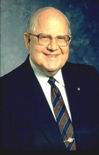
Past RI President Clifford Dochterman is a student of Rotary who has devoted considerable thought to the organization's history, including its long-standing commitment to vocational service and the promotion of high ethical standards within the professions.
"Certainly, Rotarians can be leaders in some ways to create a new atmosphere of honesty, decency, and personal responsibility in the business and professional society," Dochterman says. "But it will not be as easy, nor will it be as simple a process in today's world as it may have been in the early days of Rotary."
The world has changed, Dochterman says, since Rotary began to grow in the first half of the 20th century, when Western society tended to subscribe to absolutes. Some things were right and some things were wrong, period. There were no "in-betweens." Rotarians were influential proponents of that philosophy. But the subsequent erosion of those well-defined standards into something much more vague and conditional creates a challenge for today's ethically minded Rotarians.
"Rotarians do not have as their support the societal or universally accepted and understood beliefs in the basic tenets of truth, honesty, decency, morality, fairness, and goodness," Dochterman says. "The ethical philosophy seems to be, 'It all depends.'"
Despite that shift in society's mores, RI President-elect Glenn Estess sees a way Rotarians can promote high ethical standards every day: by acting with integrity and leading by example.
"When we do something that is out of line with our basic principles, or principles we're expected to have, not only does it affect us, but it affects all those associated with us," Estess says. "That's the reason that we in Rotary have to be ever vigilant to be sure that we are, as one friend of mine says, 'squeaky clean.'"
Grassroots Rotarians have two bedrock-strong sources of inspiration and guidance: The Four-Way Test and the Declaration of Rotarians in Businesses and Professions.

The Four-Way Test grew out of a professional challenge faced by Herbert J. Taylor, a Rotarian who was hired in 1932 to run the faltering Club Aluminum Company of Chicago. Taylor reviewed the company's operations and found some failings in its practices, including advertising that promised more than the company could deliver. Hoping to reset the business on the path to solvency and integrity, Taylor, a deeply religious man who would later serve as RI president, sat at his desk, closed his eyes, and prayed. He then jotted down a 24-word code of ethics for his employees to follow in their personal and professional lives. That code became The Four-Way Test, a simple evaluation "of the things we think, say, or do".
The Declaration of Rotarians in Businesses and Professions provides guidelines for the high ethical standards called for in the Object of Rotary. It is an eight-point plan that outlines how Rotarians incorporate service into their professional lives. Teresa Hall, governor of District 7120 (New York, USA), sees value in these tools that Rotary provides.
"The general ethical climate in the business world is pretty much at an all-time low," Hall says. "If the people involved in the wrongdoing of the recent corporate scandals thought of The Four-Way Test or the Declaration of Rotarians in Businesses and Professions beforehand, then we might find ourselves in better shape."
Hall knows firsthand the power of doing the right thing in business and setting good examples. Growing up, she watched and learned as her parents ran the family business, a television shop.
"My parents took care of all customers, regardless of their ability to pay," she says. "This was their way of giving back. My dad always told me the meaning of success was not just in dollars, but in what you could do for others, and he incorporated his vision for success with his own personal Service Above Self."
When she was introduced to Rotary and saw how similar its principles were to her father's and her own, she knew she had found the right organization, one that follows a simple yet powerful principle expressed by nearly every major religion and values system.
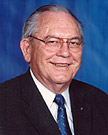 "Do unto others as you would do unto yourself
—
the old golden rule," Estess says. "It's not the big things. It's the little
things that we do on a regular basis that tell the story of what we're all
about."
"Do unto others as you would do unto yourself
—
the old golden rule," Estess says. "It's not the big things. It's the little
things that we do on a regular basis that tell the story of what we're all
about."
In the pages that follow, you'll read about how nearly 100 years after Rotary was born, its members continue to influence the way people conduct themselves in their professional lives by adhering to the little things. Some of these things may seem big — Rotarian Jim Alderson uncovered fraud that amounted to more than a billion dollars, and John Dean speculates on how Rotary ideals might have prevented one of the most infamous government scandals in U.S. history. But in one way or another, the solutions are all based on those 24 words that Herb Taylor first wrote back in 1932.